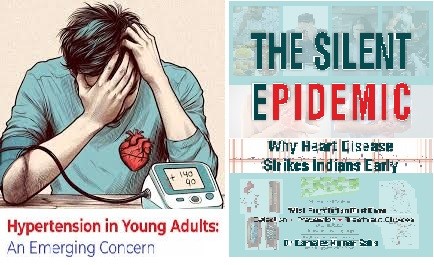
He Was 22. Not Overweight. No “Bad Habits.” His Blood Pressure Was 194/118.
Why young India can no longer say: “Heart disease is for old people.”
A 22-year-old walks into our clinic for a routine consultation.
- No obesity.
- No history of illness. * No "bad habits."
Just stress. A new job. A new city. Broken sleep. The "hustle."
He had already visited several doctors, and his blood reports looked "normal." But when we wrapped the cuff around his arm, the monitor flashed a number that stopped the room: 194/118.
Let that sink in. This is no longer an exception. This is the new face of India. We are producing a generation that looks fit on the outside but is physiologically exhausted on the inside.
The Myth of the "Old Man's Disease"
For decades, we believed heart disease was a "destination" you reached after 50—a result of a lifetime of weight gain or diabetes. Reality has shifted. Today, young professionals are showing up with "minor" complaints:
- Persistent headaches
- Chronic fatigue
- Chest heaviness (often dismissed as acidity)
- Anxiety-like palpitations
The most dangerous risk factor? The belief that you are too young to be at risk.
The Science: Your Arteries Keep Score
A major study highlighted by the American Heart Association reveals that even "modestly" high blood pressure in your 20s leaves a permanent scar.
The Math of Risk:
- A systolic pressure just 10 mmHg higher than normal increases heart disease risk by 27%.
- A diastolic pressure just 5 mmHg higher increases kidney disease risk by 16%.
- Those in the highest long-term blood pressure group are 3.5 times more likely to suffer a cardiovascular event.
The damage doesn't start during a heart attack. It starts quietly, ten years earlier, during that late-night shift or that ignored headache. Your blood vessels have a memory.
Why "Normal" Reports Can Be Misleading
The most dangerous sentence in medicine is: "My reports are normal, so I'm fine."
Blood pressure isn't a static number; it’s a story. Every month of poor sleep, every processed meal, and every "I’ll check it later" adds a chapter. Your arteries keep score even when you don’t.
Is it "Gas" or a Warning Sign?
The latest clinical guidance suggests we are losing precious time because young Indians misinterpret symptoms. Heart-related discomfort doesn't always feel like a "filmy" heart attack. It can feel like:
- Squeezing or tightness in the chest.
- Burning sensations (mistaken for acidity/GERD).
- Pain radiating to the jaw, neck, or left shoulder.
The Crisis in Numbers: Young India at Risk
Recent data shows that hypertension is already an epidemic among Indian youth. One national analysis reported:
- 11.2% of young adults have Hypertension.
- 33.3% are in the "Prehypertension" zone.
This isn't just a statistic for "patients." This is a warning for startup founders, IT professionals, night-shift workers, and students. If you are sleeping 5 hours a night and calling it "ambition," your body is paying the interest on that loan.
The Real Question
The question is no longer: "Am I too young for heart disease?" The real question is: "How long can my body absorb this lifestyle before the damage becomes irreversible?"
Early action isn't panic. It’s protection.
Whether you are a young professional dismissing fatigue or a parent worried about your child’s high-stress career, you need to understand the new rules of heart health.
Take Control Today
We have translated this growing crisis into a survival guide for the modern Indian. Don't wait for a dramatic sign—because the most dangerous signs look ordinary.
Read the eBook on Amazon India: https://www.amazon.in/dp/B0GX31SSR6
Stop postponing your health. Because while you are building your career, your heart is keeping score.
Medical Disclaimer
This content is for educational purposes only and is not a substitute for professional medical advice. Individuals with existing medical conditions or high cardiovascular risk should consult their healthcare provider before starting any new exercise routine.
ARTICLE AUTHOR
Dr Kamales Kumar Saha
Clinician–Leader · Cardiac Surgeon· Preventive Cardiologist · IICA-Certified Independent Director, Author : The Silent Epidemic
Dr Kamales Kumar Saha is a seasoned Clinician–Leader with boardroom judgment, combining deep expertise in cardiac surgery and preventive cardiology with strategic healthcare leadership. His work bridges clinical excellence and patient education— helping patients make informed, sustainable health decisions.
Copyright Notice
© 2026 Dr Kamales Kumar Saha. All rights reserved.
No part of this blog may be reproduced, stored in a retrieval system, or transmitted in any form or by any means: electronic, mechanical, photocopying, recording, or otherwise without the prior written permission of the author, except for brief quotations used in reviews or scholarly references. This book is intended for personal reading only and may not be redistributed, resold, or reproduced in any format without permission.